There is always good luck when I make these trips. On my first big grant to Korea, I was able to go almost right away to Shin Hyun-se Traditional Hanji, and he remains the best papermaker in the country when it comes to conservation-grade hanji. This time, almost right away I was able to travel with Dr. Jo to see Dr. Lee's project at Lee Sang-ok Traditional Hanji in Hamyang, near Jirisan (not to be confused with the now defunct Jirisan Hanji).
Originally I was going to miss the steaming of dak bark, but then I was at lunch with Dr. Lee in Seoul (again, he just happened to be there for work when I was there and we met in the days after my release from quarantine) and he took a phone call that delayed the big steam. A flurry of calls later, we also realized that the weekend and the March 1 independence movement holiday would force the process to be delayed with just enough time for me to finish up my first Jeonju trip and head to Jinju on the holiday. Very early the next morning, Dr. Jo picked me up, drove to the dawn market to get a box of frozen fish as a gift for the papermaking family, and we drove into the mountains. This is where Lee Sang-ok used to do the dak steaming, but has since moved the steaming location.
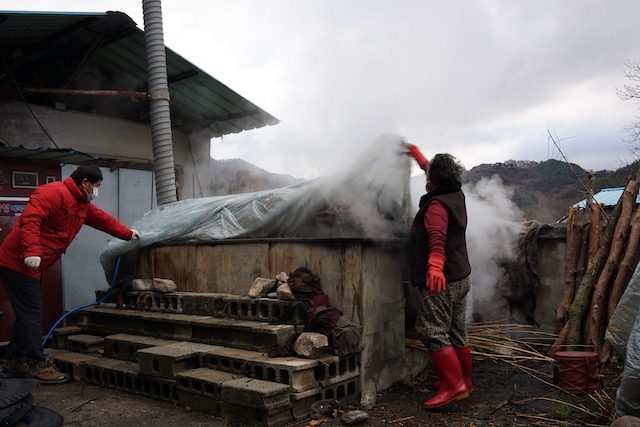
Dr. Jo said that this is the process that every photographer wants to shoot, of steam rising from the bundled dak shoots. The family must have been up very early to be able to get the fire started and the trees sufficiently steamed for stripping.
At left is Mr. Lee's younger son Lee Kwon-hee, and at right is his wife, Yoon Gong-im. This is the first time I have ever stopped to ask the supporting cast for their names. Korea's hierarchical culture and society means that names are very rarely used. Everyone is called by their relation to someone else, so I would call people "son" or "wife" or "Mrs." or "so-and-so's mom" and so on. It's only now that I even felt I could ask for names, as it feels like such an intimate ask. Unthinkable in American culture, but I seriously don't know the names of my own close family members (mostly the women, as the man's name is the most important).
Here, she is testing to see if the bark strips easily away to make sure the steaming has been successful, and it has. BTW, women in Korea do not change their names when they get married, which is why her surname differs from her husband's.
The outer bark has pulled away from the inner woody core.
They've fed water to the pile already and he is now tossing bundles to the ground to start stripping. Dr. Jo is in the middle, and Lee Sang-ok is at right. He is not in great health so his wife kept yelling at him not to work.
You can see different colors, and that's because the whole point of Dr. Lee's project is to test the amount of white bark that comes from trees in 45 different regions of the entire country. The challenge this year is that last summer was a horrible monsoon season: ENDLESS rain, too much water for the trees. Every papermaker last winter complained about how poorly the trees grew from excess water. How any of this research gets done during such drastic climate change, I have no idea.
These are the three women who came to strip bark, and I'm guessing that Dr. Jo is exhorting them to do something or other. They need to keep all of the bundles in the same batch so that the Dr. Lee's research team can keep track of them.
Of course, only after my two visits to the mill did I realize that I never got the names of these women. They are always ajumma ('auntie') to me, and that's cultural. Whether it's an problem or not is for other people to decide, but it's really different from American culture. I also generally hate to bother people while they are working. Drs. Jo and Lee had already talked a lot prior to our visit about how when outsiders come to visit papermakers, they always get in the way, slow down work, and sometimes completely stop work.
But I'm glad that Minah Song has written an essay about the reality of papermaking that will appear in the second volume of Papermaker's Tears. We had a conversation sometime during pandemic about how she dislikes when people call papermaking "magic." I am guilty of that exactly, but her point is that papermaking is not magic, it's a shit ton of hard work. And so much of that work is invisible, and done by women. Whose names are not included in the record.
At least that's my understanding of parts of her essay. All I know is that it will be REALLY good and worth buying the entire volume for when it's eventually published (I have a follow-up essay in there about two more toolmakers). Minah is the most hardcore scholar/conservator/paper person I know, and she is insanely smart, experienced, and gifted—and equipped to do research that I cannot, as she can do serious research in the three major languages of East Asia.
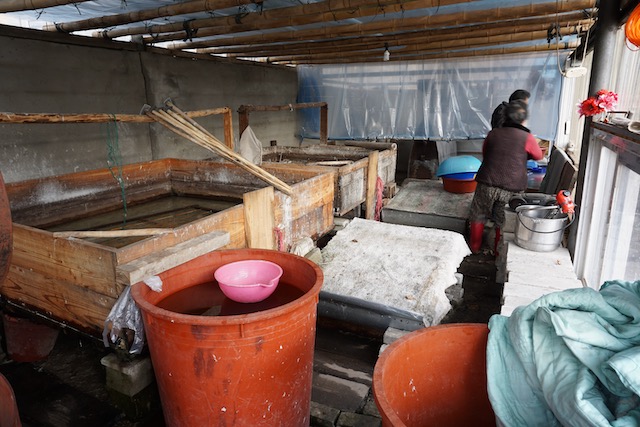
We were able to take a peek at the workspace where they actually beat, pull, and dry hanji.
This is from a book about artisans in the Jirisan area (the tallest mountain in mainland South Korea) and you can see Mr. Lee forming webal sheets. I had no idea that his mill only makes hanji in this fashion (meaning no other sheet formation styles, like the Japanese techniques you see at many other mills in Korea). I thought it was only one other mill in Korea that did that, but I've learned quickly on this trip that I have learned a lot of incorrect info. Stuff that doesn't matter to most people, but is really important to get right so that hanji's history and current state are accurately reflected.
This was one of many revelations: burdock burrs picked after the flowers wilt, dried in the shade, used to clean the bamboo screens after making paper!! We do all kinds of things in the US like spray with water (this is a great way to destroy your screens, as the nozzles and hose pressure can be super strong) and rub with toothbrushes. But apparently this is the way to go. I will try to grow some when I get back home, and hope that the deer stay away.
These are drying brushes made of Miscanthus and also another plant....if not done properly, the grasses all bloom and turn into what looks like cotton candy. I was going to do this entire post at once but realized it's too much for this platform (and me) to handle. This first trip was on 2021 March 2 and I have been very upset not to be able to post about it sooner, but that is my life right now. I also have not yet transcribed any of my notes from that visit but hope to get that done in the coming week now that I am back in Jeonju for a bit and can stay in ONE place after a month and a half of nomadic life.
Thursday, March 18, 2021
Friday, March 12, 2021
Food, only to say I did
This is a special washer/dryer for sneakers/shoes! I was fascinated by this option, even though I only have one pair I am wearing for now. It's hard to be a non-dressy person in a culture that requires women to be made up and presentable in a way that I just cannot. Dress shoes alone throw my back out, so who knows what will happen when I actually need to be out of sneakers. This was at a laundromat that I found five minutes away from my current hotel in Seoul. I went there early Saturday morning, after traveling the previous day, and was so happy to finally be able to wash (and dry! This is big, as most people hang dry here) clothes for the first time in a month (I had been hand washing the entire time).
Many friends asked me to send pictures of food in Korea. I generally don't like being asked to send pictures of anything because I'd rather be in a place, not worrying about documenting it for everyone who is not there at the time. Some people I love most in the world, though, are visual folks and will never, ever come to Korea. So this is a detour post of my reluctant food pics (I don't like to be seen taking pictures of food, or really taking pictures of anything beyond research) to show my recovery. I had thrown up so much and so violently on Mar 4 that I fasted for 40 hours. I did worry about the virus, but because I was so grossed out by the smell of the man next to me (who had been drinking a lot the prior night, apparently) on the 4-hour bus ride back to Seoul, I figured I still had my sense of smell. The first thing I attempted to eat was juk, a rice porridge that all Korean moms make for their sick kids. I went to a juk chain for this, flavored with a little soy sauce. The pink liquid is from dongchimi, or radish pickled with water.
Because I didn't want to go back to the same place for my dinner, I looked for another chain location but then stumbled upon a local market up the street, so I had juk there instead. This is pumpkin juk, with pickled cabbage on the side. It was too sweet for me but I figured the extra nutrients would be useful. All I wanted was more of the salty water during both of these meals, so I got some Gatorade after dinner because maybe it was an electrolyte deficiency.
Though I probably could have eaten that first day, I wanted to be careful because the vomiting had been so extremely unfun and exhausting. On the way to the juk place, I had noticed a haejangguk place that looked very dirty but inexpensive. That's hangover soup, and it sounded like a good idea. So on Sunday morning (Mar 7), I stepped inside and found myself to be the only woman besides the one cooking. Also, everyone had already started drinking well before I arrived, which was about 7:50am. Those places open early, and this one had been open since 6am. It was packed. Soup is my jam so this was a welcome way to start eating food again.
This is a chain coffee place that I went to for the wifi. One of the great joys of being in a country that is still relatively open during pandemic means I can go to cafés with my computer and be extremely productive. This was a late lunch or something that day, and while I doubt eggs are the best thing to eat after being this type of sick, I thought the toast would be useful. Mostly I like the design of the food prep. Dinner that night was at my family's house, so welcome!
The next day, I had been curious about how dead exactly some of the big shopping neighborhoods had become, so I went to Myeongdong. It was really dead with tons of vacant shops for rent, but then again, it was also morning. I had wanted to go to a department store for food court food but it was closed, so I went to the top of a building that advertised lots of non-Korean food. This is what passes for Indian food but it is not even close. The rice was the most hilarious, because it's regular sticky Korean rice! Thankfully I had arrived prior to noon because as soon as lunchtime rolled around, the place filled up so quickly that the one server turned the sign from "open" to "closed" (people still came in). Koreans do not play with meal times, so you eat right at meal times, no waiting or putting off or eating late meals.
My cousin was on her one day off a week that day, so she called me in the afternoon and I invited myself over. We ran some errands together and on the way home, she pulled over to this chicken place and yelled out the window to see if we could get the one fully roasted chicken to go (it was on the spit where the 5 new ones are at the very top). They are stuffed with chapssal (a very sticky rice, sometimes called sweet rice even though it's not sweet) and served after slicing the bird in half and searing the rice.
It was delicious. Partly because it was, and more likely because because I was with my beloved cousin, who basically taught me to speak Korean again when I was 20 years old one summer during college when I lived with her and her family. This one particular branch of my family is like my parents/siblings away from home, and we start right up as if no time has passed. I never would have been able to do what I've done in Korea without them.
I didn't take pictures of my meals the next day (noodle soup and teriyaki chicken) because I was with friends who are normal Koreans (not exactly, as both have spent time abroad and understand what it means to be a strong woman who makes her own career—which both have done admirably). The following day, I went to a market that is known for certain food but then ate other stuff, which is probably dumb but I was hungry. This bibimbap and mandu were extremely lackluster. Again, this is because for me, eating alone is not my preference. Luckily, I was able to join my family for dinner that night; home cooked meals are all I want these days, because I can't cook for myself in the hotel.
The next day, I didn't get out until the afternoon because of a lot of checking out and checking in and packing and repacking and unpacking (at the same hotel, because I originally thought by now that I'd be further south doing research but I can't go until next week due to various logistics). I had noticed the corn at a street vendor across from the hotel but this time, while buying waterproof aprons at Namdaemun market, I walked past another vendor. I kept going but when I saw two little children eating corn in the street, I turned around and got some for myself. I didn't appreciate this very chewy corn as much when I was a child visiting Korea but I really wanted some. This corn is nothing like the stuff back home, extremely chewy, so I had a headache afterwards because my jaws are already a mess but had to do a lot of work. I don't regret it!
I finally got to the department store for food but always make the mistake (almost intentionally...) of not ordering what the place is famous for. I wasn't in the mood for naengmyun (cold noodles) so I had gukbap ("soup" + "rice") instead. By the time I got home, I was exhausted, and I've generally felt like I get more tired by doing less than usual. I would never ever normally spend so much time in Seoul with no appointments, but I've done it intentionally to try and recover before I start traveling again on Monday. Hopefully then I can finally stay in one place and unpack completely out of my suitcases, instead of constantly weighing in my head and hands what to take or not take. And once I can go from dormitory to office on campus, I can start to write in earnest.
Many friends asked me to send pictures of food in Korea. I generally don't like being asked to send pictures of anything because I'd rather be in a place, not worrying about documenting it for everyone who is not there at the time. Some people I love most in the world, though, are visual folks and will never, ever come to Korea. So this is a detour post of my reluctant food pics (I don't like to be seen taking pictures of food, or really taking pictures of anything beyond research) to show my recovery. I had thrown up so much and so violently on Mar 4 that I fasted for 40 hours. I did worry about the virus, but because I was so grossed out by the smell of the man next to me (who had been drinking a lot the prior night, apparently) on the 4-hour bus ride back to Seoul, I figured I still had my sense of smell. The first thing I attempted to eat was juk, a rice porridge that all Korean moms make for their sick kids. I went to a juk chain for this, flavored with a little soy sauce. The pink liquid is from dongchimi, or radish pickled with water.
Because I didn't want to go back to the same place for my dinner, I looked for another chain location but then stumbled upon a local market up the street, so I had juk there instead. This is pumpkin juk, with pickled cabbage on the side. It was too sweet for me but I figured the extra nutrients would be useful. All I wanted was more of the salty water during both of these meals, so I got some Gatorade after dinner because maybe it was an electrolyte deficiency.
Though I probably could have eaten that first day, I wanted to be careful because the vomiting had been so extremely unfun and exhausting. On the way to the juk place, I had noticed a haejangguk place that looked very dirty but inexpensive. That's hangover soup, and it sounded like a good idea. So on Sunday morning (Mar 7), I stepped inside and found myself to be the only woman besides the one cooking. Also, everyone had already started drinking well before I arrived, which was about 7:50am. Those places open early, and this one had been open since 6am. It was packed. Soup is my jam so this was a welcome way to start eating food again.
This is a chain coffee place that I went to for the wifi. One of the great joys of being in a country that is still relatively open during pandemic means I can go to cafés with my computer and be extremely productive. This was a late lunch or something that day, and while I doubt eggs are the best thing to eat after being this type of sick, I thought the toast would be useful. Mostly I like the design of the food prep. Dinner that night was at my family's house, so welcome!
The next day, I had been curious about how dead exactly some of the big shopping neighborhoods had become, so I went to Myeongdong. It was really dead with tons of vacant shops for rent, but then again, it was also morning. I had wanted to go to a department store for food court food but it was closed, so I went to the top of a building that advertised lots of non-Korean food. This is what passes for Indian food but it is not even close. The rice was the most hilarious, because it's regular sticky Korean rice! Thankfully I had arrived prior to noon because as soon as lunchtime rolled around, the place filled up so quickly that the one server turned the sign from "open" to "closed" (people still came in). Koreans do not play with meal times, so you eat right at meal times, no waiting or putting off or eating late meals.
My cousin was on her one day off a week that day, so she called me in the afternoon and I invited myself over. We ran some errands together and on the way home, she pulled over to this chicken place and yelled out the window to see if we could get the one fully roasted chicken to go (it was on the spit where the 5 new ones are at the very top). They are stuffed with chapssal (a very sticky rice, sometimes called sweet rice even though it's not sweet) and served after slicing the bird in half and searing the rice.
It was delicious. Partly because it was, and more likely because because I was with my beloved cousin, who basically taught me to speak Korean again when I was 20 years old one summer during college when I lived with her and her family. This one particular branch of my family is like my parents/siblings away from home, and we start right up as if no time has passed. I never would have been able to do what I've done in Korea without them.
I didn't take pictures of my meals the next day (noodle soup and teriyaki chicken) because I was with friends who are normal Koreans (not exactly, as both have spent time abroad and understand what it means to be a strong woman who makes her own career—which both have done admirably). The following day, I went to a market that is known for certain food but then ate other stuff, which is probably dumb but I was hungry. This bibimbap and mandu were extremely lackluster. Again, this is because for me, eating alone is not my preference. Luckily, I was able to join my family for dinner that night; home cooked meals are all I want these days, because I can't cook for myself in the hotel.
The next day, I didn't get out until the afternoon because of a lot of checking out and checking in and packing and repacking and unpacking (at the same hotel, because I originally thought by now that I'd be further south doing research but I can't go until next week due to various logistics). I had noticed the corn at a street vendor across from the hotel but this time, while buying waterproof aprons at Namdaemun market, I walked past another vendor. I kept going but when I saw two little children eating corn in the street, I turned around and got some for myself. I didn't appreciate this very chewy corn as much when I was a child visiting Korea but I really wanted some. This corn is nothing like the stuff back home, extremely chewy, so I had a headache afterwards because my jaws are already a mess but had to do a lot of work. I don't regret it!
I finally got to the department store for food but always make the mistake (almost intentionally...) of not ordering what the place is famous for. I wasn't in the mood for naengmyun (cold noodles) so I had gukbap ("soup" + "rice") instead. By the time I got home, I was exhausted, and I've generally felt like I get more tired by doing less than usual. I would never ever normally spend so much time in Seoul with no appointments, but I've done it intentionally to try and recover before I start traveling again on Monday. Hopefully then I can finally stay in one place and unpack completely out of my suitcases, instead of constantly weighing in my head and hands what to take or not take. And once I can go from dormitory to office on campus, I can start to write in earnest.
Tuesday, March 09, 2021
Dream team
Left: Dr. Jo Hyun-jin. Right: Dr. Lee Oh-kyu. These two powerhouses were my endlessly generous hosts in Jinju, and in this image are showing me the samples of hanji made for the first time by two people at once since way back when hanji was made this way. Mr. Shin Hyun-se, easily the best papermaker in the country, made these huge sheets with his current apprentice. Fingers crossed that I get to see them soon.
Dr. Jo has been working with hanji for 40 years and we both talked about how it was a shame that we weren't able to connect sooner. We had met briefly in 2014 but only now have been able to spend genuine time together. In his mid-60s, he has about 10x the energy that I do, and is easily the person who knows the most about hanji, from the small to big pictures, from on-the-ground and in-the-studio work than anyone else here.
He has spent years learning how to be able to dye hanji with natural dyes perfectly evenly. This is something that almost no one does, because it's hard. It's really, really hard. This is why you always see mottled dyed papers or paper "with character" because to get a large sheet one even color is extremely difficult. I know this, which is why I don't even try to do it. I leave that to the pros, even though in some sad ways, there are almost no pros. He also has spent enormous amounts of time, energy, and funds to figure out ways to use hanji in new and old ways. This is a light covered in hanji.
Of course he also dyes paper in dynamic ways, and has a whole separate space to do that work.
This is a lovely example of his dyed and textured and coated hanji. Because it's not enough to just get the paper to be a nice even color. It needs to be durable, so he uses joomchi techniques and has come up with his own method of coating and making hanji leather, which he turns into handbags, shoes, and a ton of other things.
Held up to the light. He is good about working and collaborating with other people, and I believe another artist did the bojagi work on this.
The garments are also made of hanji.
Dr. Jo knows tons of intangible cultural property holders. In this case, a fan maker. Dr. Jo dyes the hanji and then takes it to other people to use.
Black, especially natural black, is really hard to get on any handmade paper.
The lighting wasn't great but this is a fan made of taeji, hanji made with inclusions of fresh-water algae in the Spirogyra genus. It's hard to find these days but the paper is gorgeous. This taeji project is one that Dr. Lee has been working on through his work at the National Institute of Forest Science as a senior research scientist.
This tree has hung out for a long time at the institute, and I was able to visit on a beautiful day. It's warmer down south (the bus ride to Seoul from Jinju is 4 hours) so there were more blooms in general as well. Dr. Jo used to work here so he is familiar with all of the plants, so it was like visiting old friends. Dr. Lee has degrees in forest science and chemistry, and spent many years doing his graduate and doctoral work in Maine. He came upon hanji late in his career and found it shocking that so little research has been done about it in different realms, whether from a historical perspective or scientific. Fortunately, he has been able to work with Dr. Jo and they make an amazing team.
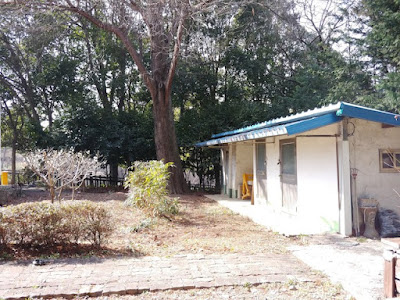
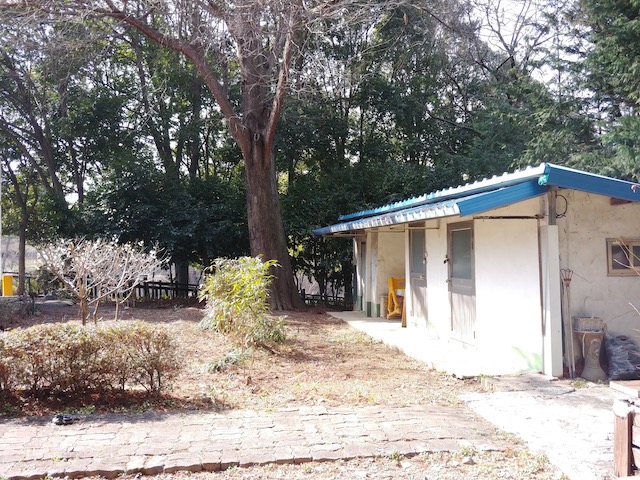
He and Dr. Jo walked me around the grounds, which of course are covered with trees of different types and I definitely could not keep track of them all. But it's my favorite kind of work, a nature walk. I remember doing them as a child in school, but obviously I am not great at observation because I still can't tell what poison ivy looks like. This is not the original building, but the general site of Dr. Jo's former hanji research studio. Opposite are trees that you'd use to make hanji. I may do a separate post on this but OMG. I was in shock when I saw that the institute has a GINORMOUS hanji studio that is laying empty. Two or more of everything (here are the knife beaters, known to some as naginata machines), in an incredibly well-equipped lab. I just could not believe it. As someone who has spent the greater part of her professional life building hanji studios or trying to get existing spaces to accommodate hanji making, this is like walking into heaven. Except that it's not being used. I wanted to scream. The joke was that I should come and use it. If only!
Dr. Jo was trying to show me how to differentiate different types of bamboo by the hairs coming out of the base of the leaves. This is not my forte but I still love attempting to learn.
They warned me that this is not even all of the bamboo on the institute grounds. It certainly was not but even this was so much more than I had been able to inspect.
Dr. Jo also pointed out this old tree that has been on the grounds for a very long time.
It's special because it is actually two trees that grew together into one!
Okay, back to Dr. Lee's enormous project: he is gathering paper mulberry trees from all over Korea, at least 45 different regions, to find out how much bast fiber each type/area produces. This is an exquisite combination of lab work and hanji folks because it requires everyone to work together while doing what they do best. In this batch is last year's haul, which meant harvesting, steaming, stripping, and scraping bark. While keeping each batch together, not mixing them, and weighing and keeping records at every step.
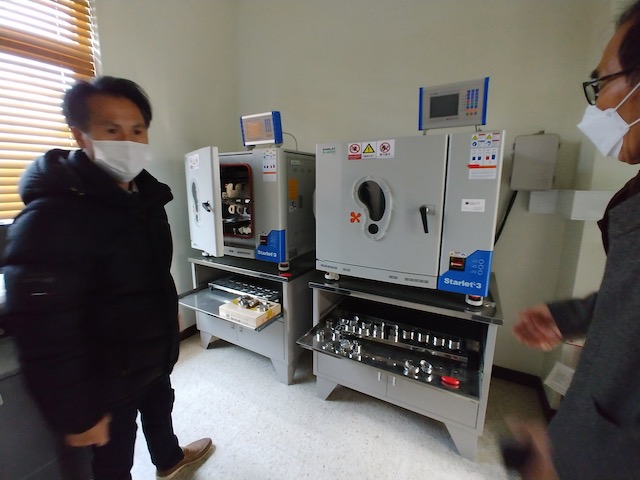
We're not talking about the stuff I do, like weighing on a baby scale. This project requires millions of dollars of lab equipment and space. Don't ask me about what these expensive machines do. Dr. Lee explained everything in each lab but I think my mind had already exploded by then and I was just trying to keep up taking notes and pictures while gawking behind my mask.
This is the biggest paper mulberry tree in Jinju, which Dr. Jo located and Dr. Lee got the funding to move. That was a giant and expensive project, because it was on school grounds growing in between a wall and a building, so the whole building had to be knocked down. It was pruned so that the tree doesn't have to try and send nutrients up right now because they want it to take root properly. There's an entire mechanism around it where under the plastic there is a band full of holes wrapped around the base so that the roots can poke out and go into the ground more easily. I'm not sure if you can tell, but at this point of my trip (my last evening), I wanted to collapse. I was very sick.
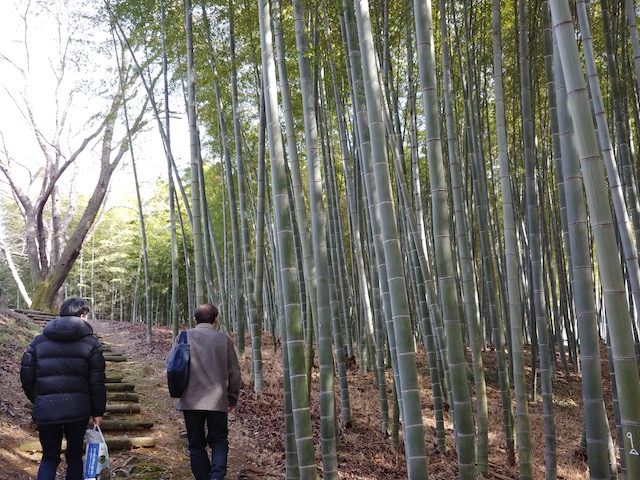
But I didn't want to give up my chance to see the huge bamboo forests that we didn't get to see on the prior day because the sun set. Of course it was raining on this day but it was still beautiful. Dr. Lee at this point insisted upon seeing me take pictures that I walk ahead of him so that I could get unobstructed images, but all I wanted to do was lag behind because I was so ill.
More about my illness later (I'm fine now, just trying to take it easy, which for those who know me is very hard) but my four days in Jinju were incredible! This is not even scratching the surface, but I wanted to try and post before I get swallowed up by the next thing. Meeting these two was a welcome surprise and the biggest gift, to be able to meet people who really get hanji and are actively working to keep it healthy, so early on in my trip.
Dr. Jo has been working with hanji for 40 years and we both talked about how it was a shame that we weren't able to connect sooner. We had met briefly in 2014 but only now have been able to spend genuine time together. In his mid-60s, he has about 10x the energy that I do, and is easily the person who knows the most about hanji, from the small to big pictures, from on-the-ground and in-the-studio work than anyone else here.
He has spent years learning how to be able to dye hanji with natural dyes perfectly evenly. This is something that almost no one does, because it's hard. It's really, really hard. This is why you always see mottled dyed papers or paper "with character" because to get a large sheet one even color is extremely difficult. I know this, which is why I don't even try to do it. I leave that to the pros, even though in some sad ways, there are almost no pros. He also has spent enormous amounts of time, energy, and funds to figure out ways to use hanji in new and old ways. This is a light covered in hanji.
Of course he also dyes paper in dynamic ways, and has a whole separate space to do that work.
This is a lovely example of his dyed and textured and coated hanji. Because it's not enough to just get the paper to be a nice even color. It needs to be durable, so he uses joomchi techniques and has come up with his own method of coating and making hanji leather, which he turns into handbags, shoes, and a ton of other things.
Held up to the light. He is good about working and collaborating with other people, and I believe another artist did the bojagi work on this.
The garments are also made of hanji.
Dr. Jo knows tons of intangible cultural property holders. In this case, a fan maker. Dr. Jo dyes the hanji and then takes it to other people to use.
Black, especially natural black, is really hard to get on any handmade paper.
The lighting wasn't great but this is a fan made of taeji, hanji made with inclusions of fresh-water algae in the Spirogyra genus. It's hard to find these days but the paper is gorgeous. This taeji project is one that Dr. Lee has been working on through his work at the National Institute of Forest Science as a senior research scientist.
This tree has hung out for a long time at the institute, and I was able to visit on a beautiful day. It's warmer down south (the bus ride to Seoul from Jinju is 4 hours) so there were more blooms in general as well. Dr. Jo used to work here so he is familiar with all of the plants, so it was like visiting old friends. Dr. Lee has degrees in forest science and chemistry, and spent many years doing his graduate and doctoral work in Maine. He came upon hanji late in his career and found it shocking that so little research has been done about it in different realms, whether from a historical perspective or scientific. Fortunately, he has been able to work with Dr. Jo and they make an amazing team.
He and Dr. Jo walked me around the grounds, which of course are covered with trees of different types and I definitely could not keep track of them all. But it's my favorite kind of work, a nature walk. I remember doing them as a child in school, but obviously I am not great at observation because I still can't tell what poison ivy looks like. This is not the original building, but the general site of Dr. Jo's former hanji research studio. Opposite are trees that you'd use to make hanji. I may do a separate post on this but OMG. I was in shock when I saw that the institute has a GINORMOUS hanji studio that is laying empty. Two or more of everything (here are the knife beaters, known to some as naginata machines), in an incredibly well-equipped lab. I just could not believe it. As someone who has spent the greater part of her professional life building hanji studios or trying to get existing spaces to accommodate hanji making, this is like walking into heaven. Except that it's not being used. I wanted to scream. The joke was that I should come and use it. If only!
Dr. Jo was trying to show me how to differentiate different types of bamboo by the hairs coming out of the base of the leaves. This is not my forte but I still love attempting to learn.
They warned me that this is not even all of the bamboo on the institute grounds. It certainly was not but even this was so much more than I had been able to inspect.
Dr. Jo also pointed out this old tree that has been on the grounds for a very long time.
It's special because it is actually two trees that grew together into one!
Okay, back to Dr. Lee's enormous project: he is gathering paper mulberry trees from all over Korea, at least 45 different regions, to find out how much bast fiber each type/area produces. This is an exquisite combination of lab work and hanji folks because it requires everyone to work together while doing what they do best. In this batch is last year's haul, which meant harvesting, steaming, stripping, and scraping bark. While keeping each batch together, not mixing them, and weighing and keeping records at every step.
We're not talking about the stuff I do, like weighing on a baby scale. This project requires millions of dollars of lab equipment and space. Don't ask me about what these expensive machines do. Dr. Lee explained everything in each lab but I think my mind had already exploded by then and I was just trying to keep up taking notes and pictures while gawking behind my mask.
This is the biggest paper mulberry tree in Jinju, which Dr. Jo located and Dr. Lee got the funding to move. That was a giant and expensive project, because it was on school grounds growing in between a wall and a building, so the whole building had to be knocked down. It was pruned so that the tree doesn't have to try and send nutrients up right now because they want it to take root properly. There's an entire mechanism around it where under the plastic there is a band full of holes wrapped around the base so that the roots can poke out and go into the ground more easily. I'm not sure if you can tell, but at this point of my trip (my last evening), I wanted to collapse. I was very sick.
But I didn't want to give up my chance to see the huge bamboo forests that we didn't get to see on the prior day because the sun set. Of course it was raining on this day but it was still beautiful. Dr. Lee at this point insisted upon seeing me take pictures that I walk ahead of him so that I could get unobstructed images, but all I wanted to do was lag behind because I was so ill.
More about my illness later (I'm fine now, just trying to take it easy, which for those who know me is very hard) but my four days in Jinju were incredible! This is not even scratching the surface, but I wanted to try and post before I get swallowed up by the next thing. Meeting these two was a welcome surprise and the biggest gift, to be able to meet people who really get hanji and are actively working to keep it healthy, so early on in my trip.
Saturday, March 06, 2021
The whole reason I came here: toolmakers
I feel extremely behind, which is because I still haven't realized that the whole concept of being caught up on things is a lie, but here I am on my hamster wheel. I've actually been thrown off of it, but more on that later. This is going up a big hill in Jeonju and I love that here, they lay down textiles outdoors. Even on construction sites, you see carpets of felt (probably synthetic, but still quite useful).
On the way to find food, I passed this storefront.
This was a silly and very touristy gimmick but I fell for it and waited in line for a stick of cheese.
But back to the heart of things: screens for hanji making! Only one couple is left doing this in all of Korea, which is basically the same state it was in when I began this research 14 years ago. It was alarming then and feels even worse now as the designated intangible cultural property holder, Mr. Yoo, is not in great shape. This is not a screen, but a washboard used for rubbing shaved splints to smooth them out before weaving.
This is the draw plate used to shave those splints.
And the knife used to separate inner from outer bamboo, and then start splints, and to bevel them down to prepare to draw through the plate. This one tool seems to be the main knife for everything. As I have learned (sometimes quite painfully) over the years, a good knife is extremely important and often very hard to find, but will last a lifetime.
This held the most delightful bits for me: fingers of rubber gloves! I have always wanted to do things like this, and generally also get excited when I see finger cots. Mr. Yoo's wife Seo Jeong-im does the lion's share of the work now and is obviously very good with her hands.You can see how she has sewn the rubber fingers onto cloth gloves, which go over single cots for extra protection. She said you have to protect your hands and that bamboo splinters are no joke.
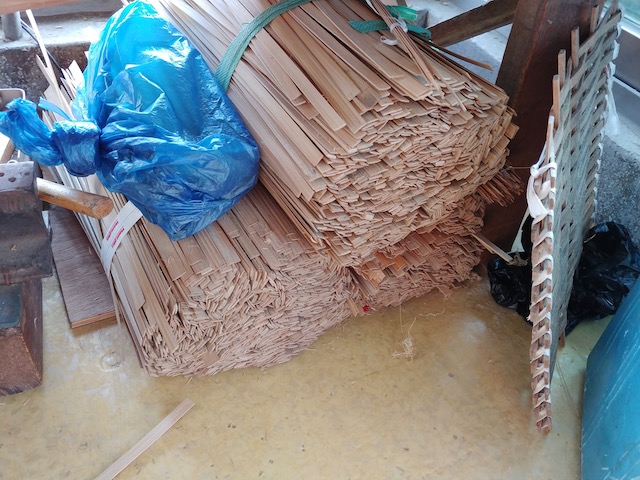
These are the outer parts of bamboo, nodes removed, and sometimes you have to shave away excess inner bits with that knife and those gloves and extra finger protectors before shaving through the drawplate.
These are the bobbins/weights used for weaving. Lots of opinions on how to make or buy versions. The funny thing, is that before I returned to try and interview the couple, I skimmed the part of my book about them. I forgot that I had done all of that research so long ago, and I answered my own questions! BTW, the hardcover version is sold out, going into paperback this month.
I couldn't resist taking these photos because she loves their dog so much. I'll make an order soon for a new bal, as soon as I decide on what size I need, and then it will go into the little pink spiral bound book.
On the way to find food, I passed this storefront.
This was a silly and very touristy gimmick but I fell for it and waited in line for a stick of cheese.
But back to the heart of things: screens for hanji making! Only one couple is left doing this in all of Korea, which is basically the same state it was in when I began this research 14 years ago. It was alarming then and feels even worse now as the designated intangible cultural property holder, Mr. Yoo, is not in great shape. This is not a screen, but a washboard used for rubbing shaved splints to smooth them out before weaving.
This is the draw plate used to shave those splints.
And the knife used to separate inner from outer bamboo, and then start splints, and to bevel them down to prepare to draw through the plate. This one tool seems to be the main knife for everything. As I have learned (sometimes quite painfully) over the years, a good knife is extremely important and often very hard to find, but will last a lifetime.
This held the most delightful bits for me: fingers of rubber gloves! I have always wanted to do things like this, and generally also get excited when I see finger cots. Mr. Yoo's wife Seo Jeong-im does the lion's share of the work now and is obviously very good with her hands.You can see how she has sewn the rubber fingers onto cloth gloves, which go over single cots for extra protection. She said you have to protect your hands and that bamboo splinters are no joke.
These are the outer parts of bamboo, nodes removed, and sometimes you have to shave away excess inner bits with that knife and those gloves and extra finger protectors before shaving through the drawplate.
These are the bobbins/weights used for weaving. Lots of opinions on how to make or buy versions. The funny thing, is that before I returned to try and interview the couple, I skimmed the part of my book about them. I forgot that I had done all of that research so long ago, and I answered my own questions! BTW, the hardcover version is sold out, going into paperback this month.
I couldn't resist taking these photos because she loves their dog so much. I'll make an order soon for a new bal, as soon as I decide on what size I need, and then it will go into the little pink spiral bound book.
Subscribe to:
Posts (Atom)